
Zone Compression: Making Faster Feel Easier
By Coach Rich Pady, Healthy Results Training
If you’ve trained with us for any length of time, you know we talk a lot about zones. Zone 2 for your easy days. Threshold for those steady, controlled efforts. VO2 max for the short, sharp intervals that make you question your life choices. Zones give us a shared language, and they keep your easy days easy.
But there’s a new idea in endurance coaching that changes how we think about the space between those zones, and it’s worth understanding. It’s called Zone Compression, a training theory developed by coaches David and Megan Roche of SWAP Running. David is the Leadville 100 course record holder, and the pair coach some of the top road and trail runners in the United States, including Jessica McClain, who finished second at this month’s New York City Marathon.
What is Zone Compression?
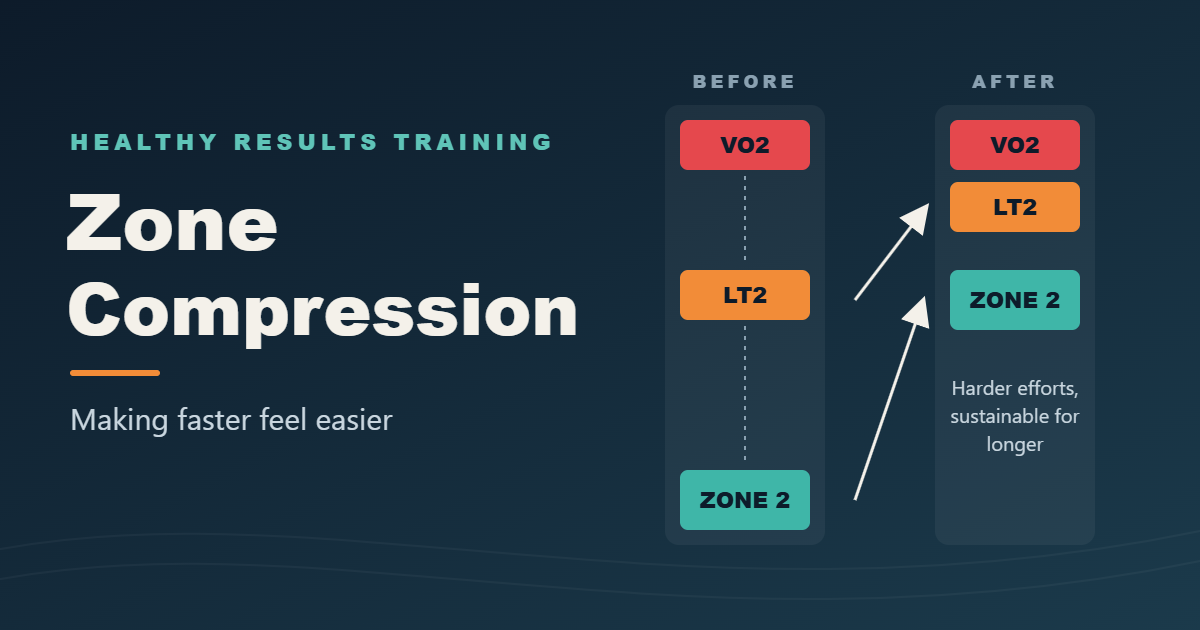
Think of your training intensities as a ladder. At the bottom is Zone 2 (around your first lactate threshold, LT1), which you can hold for hours with good fuelling. Above that is your second threshold (LT2, roughly what you could race for 30–60 minutes). Higher still is VO2 max, sustainable for maybe 10–20 minutes, and above that, all-out anaerobic efforts.
For most athletes, the rungs on that ladder are spread far apart. Zone Compression is the idea that, with the right training, you can pull those rungs closer together. In plain terms: the goal is to make harder efforts sustainable for longer by improving how your aerobic system handles fatigue.
The Roches suggest this process is behind many of the big performance leaps we’ve seen in recent years, including athletes running marathons at a pace that, a decade ago, we would have called threshold.
It starts in the same place for everyone
Here’s the part I love: according to the Roches, Zone Compression doesn’t start with anything exotic. Whether you’re training for a 5K, a marathon or an Ironman, it begins with the same goal: pushing your threshold up toward your VO2 max. And in practice, most of that work looks like good, old-fashioned aerobic development.
In other words, this isn’t a licence to run every day hard. It’s a reason to do your easy days well, so you can do your quality days really well.
The three ingredients
1. Keep some speed in your legs. Short hill sprints, strides and occasional fast intervals keep your top end sharp. If the ceiling rises, there’s more room to push your threshold up underneath it.
2. Build aerobic efficiency at higher speeds. Threshold work, steady running and controlled pace changes teach your body to process fatigue at faster paces, so those paces start to feel sustainable rather than desperate.
3. Fuel the work. This is a big one. The Roches tie Zone Compression closely to the “high-carb revolution” in endurance sport. Good carbohydrate availability is what lets you train hard and absorb it. Fuelling isn’t just a race-day concern; it’s part of how you build your engine. (This is exactly why we put carb targets on every session over two hours.)
What it looks like in a workout
A couple of example sessions that reflect the idea:
- Hills into threshold: 5 × 3 minutes uphill at a strong effort, then roll straight into 15 minutes of controlled threshold or steady running. You learn to settle into a fast, sustainable rhythm while already carrying fatigue.
- Alternating paces: Alternate 800 m at 10K effort with 800 m at marathon effort, with no full stop between them. The goal is to keep running efficiently after the harder segments, rather than falling apart.
These aren’t sessions to try on your own tomorrow. They’re the kind of work we layer in once your aerobic base is solid and your easy days are truly easy.
A healthy dose of caution
Zone Compression is a theory, not settled science. Some of the proposed mechanisms (how mitochondria and lactate handling adapt) still need to be validated by research. And the Roches themselves are among the loudest voices saying that most runners still do too much intensity, not too little.
So the principle we take from it is this: a strong aerobic base, a little speed, smart threshold work and serious fuelling, done consistently, can make faster paces feel more and more within your reach.
What this means for you
If you’re a Healthy Results athlete, you’re already doing much of this. Your plan protects your easy days, keeps strides and hills in the mix, builds threshold work progressively, and asks you to fuel your longer sessions. Over a season, the goal is that the gap between “comfortable” and “fast” gets smaller.
That’s Zone Compression in a nutshell: not training harder, but teaching your body to make fast feel more like steady.
Questions? Bring them to your next check-in, or reach out to me directly.
— Coach Rich
Further reading